
 |
 |
 |
 |
 |
 |
 |
Reviews of See Sharp Press Books
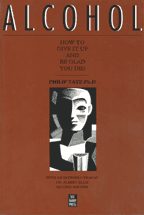 Alcohol: How to Give It Up and Be Glad You Did (second edition), by Philip Tate.
"This book is an insightful and practical approach to help the reader eliminate his/her alcohol or
substance abuse. . . . Not only does it teach how to eliminate and addiction, it also encourages
readers to participate in their therapy, and like any good therapy program of recovery, Dr. Tate
not only gives sound principles, but he also offers many specific ideas about how to deal with
the main unhelpful emotions . . . [This book] has the potential to become a classic on the
subject of substance abuse and treatment."
[ Back to Books ] 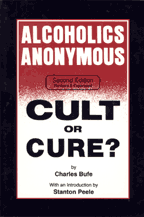 Alcoholics Anonymous: Cult or Cure? (second edition, revised & expanded), by Charles Bufe.
Introduction by Stanton Peele.
Alcoholics Anonymous: Cult or Cure? (second edition, revised & expanded), by Charles Bufe.
Introduction by Stanton Peele.
"Lots of substance, presented with style. . . . The title of this book will serve as an effective marketing device, but does not do justice to its content that reaches far beyond the two questions it asks. What impressed me most was the author's research, the depth of his insights, and the logical consistency of his conclusions." —Vince Fox, The Journal of Rational Recovery, July/August 1991 (on the original, much shorter version of the book)
"Both supporters and critics of AA could benefit from reading this factual book."
"This book is exceptionally well written because it is articulate, objective, concise, and complete. . . .
This book is an example of honesty and balance, in other words critical thinking. This is an important
book for the general public because most people know of someone who is a problem drinker and
assume that AA is the answer to their problems. It is an important book for skeptics who
wonder if AA is all that it is cracked up to be. It is an important book for problem drinkers
who find it difficult to accept the principles of AA. It is especially important for AA members . . ."
ISBN 1-884365-12-4 / 208 pp.
 The Anarchist Cookbook, by Keith McHenry with Chaz Bufe, introduction by Chris Hedges.
"No, it's not that one. This one borrows the title and the stenciled cover art of antiwar activist William Powell's 1971 tirade, but it opens with Powell's own 2013 disavowal of his original manual . . . Newly published, prefaced by a typically charged introduction by Chris Hedges, the 2015 publication of The Anarchist Cookbook features a lively tone and inspiring argument. . . [An] affordable and handsomely produced compendium."
ISBN 978-1-937-27676-8 / 154 pp. (8.5"x11")
 The Anti-Christ, by Friedrich Nietzsche.
"Bombastic, acerbic, and coldly analytical, The Anti-Christ exemplifies the muscularity
of thought that surrounds the Nietzsche legend. . . . This rich volume represents a profound
parting shot from perhaps the most significant philosopher of the 19th century."
ISBN 1-884365-20-5 / 96 pp. [ Back to Books ] 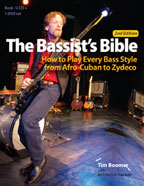 The Bassist's Bible: How to Play Every Bass Style from Afro-Cuban to Zydeco, by Tim Boomer, with Mick Berry and Chaz Bufe.
"This cool new book seeks to describe all that the average player will need to know to have a workable familiarity with nearly every common musical style. Each style is listed alphabetically, and each entry includes a historical background, hallmarks of the groove, gear, chord progressions, and tempos typical of the style, and a variety of musical examples reinforced by the included play-along CD. Naturally, mainstream styles like rock, blues, and R&B [are included], but so are Klezmer, ethnic wedding dances, and Afro-Cuban. The Bassist's Bible will prove useful on many a working pros reference shelf."
ISBN 1-884365-45-0 / 261 pp. (8.5" X 11") + 2 CDs + DVD [ Back to Books ] [ See pdf sample ]
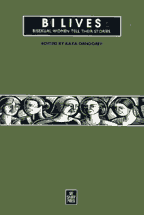 Bi Lives: Bisexual Women Tell Their Stories, Kata Orndorff, editor.
Eighteen interviews with bisexual women reveal a vast range of backgrounds and adult
experiences, from childhoods in urban settings to youth spent on a southern Virginia farm,
from a woman currently married and monogamous as well as not very sexual to one who is now
nonmonogamous with both a woman and a man. "Susan," age 43 and an incest
survivor, regards her bisexual activities as reflecting
her need to please and be praised for being "hot."
Radical feminist political organizer "Lani" ponders
the philosophy of lesbian separatism and the hurt she
endured because of it. HIV-positive "Mary" had been
in an open relationship with a man, and both enjoyed
going to parties and "playing" before learning of his
HIV status (when interviewed, her health was failing,
but an epilogue reveals that later her viral load
diminished). Along with the interviews come
safer-sex guidelines and a bisexual resource list,
which round the book out as a valuable resource for
collections strong in sexuality issues and women's studies.
"The new book, Bi Lives: Bisexual Women Tell Their Stories, is another opportunity to
revel in our multiplicities . . . Bi Lives is a good addition to the growing library of
bi-related non fiction books. It gives an interesting view into bi women's lives and the
intricacies of life in general."
"It's about time bisexual women got some resources for their very own. Highly Recommended."
"A good 'beginner' bisexual books, Bi Lives focuses more on personal experiences than on
politics or theory. Women who don't know other bisexual women or don't have access to a bisexual
community will find the book particularly valuable. I would recommend it to women who are
just coming out as biseuxal, to those who are questioning their sexuality or to anyone who wants
to know more about bisexual women from a personal perspective. This book is an easy read and
quite accessible."
ISBN 1-884365-09-6 / 250 pp. [ Back to Books]
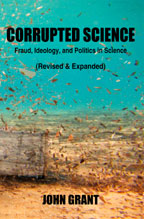 Corrupted Science: Fraud, Ideology, and Politics in Science (revised & expanded), , by John Grant.
"I was a huge fan of this book when it was first released as a small hardcover 10 years ago. Now it's back in a much larger and massively updated format. Grant (an award-winning science-fiction writer and editor) looks at centuries of history to expose how science has been misused and misrepresented since the age of Galileo — and into the modern climate-change denial movement and the Trump administration."
ISBN 978-1-947071-00-1 / 448 pp. [ Back to Books]
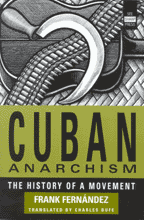 Cuban Anarchism: The History of a Movement, by Frank Fernández.
Translation and Introduction by Chaz Bufe.
Cuban Anarchism: The History of a Movement, by Frank Fernández.
Translation and Introduction by Chaz Bufe.
"An amazing book, starting with the importation of anarchist ideals during the mid-1800s and ending with an evaluation and criticism of Castro's dictatorship.
"Cuban Anarchism . . . provides a broad view of the history of Cuban anarchism. It is especially valuable for the post-1925 period
. . . Fernandez rescues from oblivion the many anarchist activists, organizations, and unions seldom
mentioned in the existing literature on the Cuban labour movement. . . Fernandez's book has broken new ground."
"Cuban Anarchism: The History of a Movement, would be a welcome addition to any
anarchist's library. It's important not only as a history of Cuban Anarchism, but as a
cautionary tale . . ."
ISBN 1-884365-19-1 / 154 pp. [ Back to Books] [ See Excerpt ]
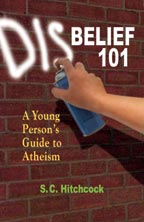 Disbelief 101: A Young Person's Guide to Atheism, by S.C. Hitchcock
"Sure to outrage religious readers, and not just fundamentalists, this chatty, totally irreverent title, written
under a pseudonym [by Chris Edwards, author of Spiritual Snake Oil], speaks to teen rebels of all faiths who question religious indoctrination. The book is
really an expansion of a single statement: "God doesn't exist." Readers can dip in wherever they like to
find support for their arguments against the nonbelievers or to find their own doubts reflected. The chapter
on evolution versus creationism and intelligent design spells the author's position in clear language:
evolution is not a belief; there is factual evidence. Faith is the f-word here; how do we know that hell
exists if people only go there after they're dead? And the author says to forget compromise: science and
religion cannot co-exist. Yes, Hitchcock writes, Jesus did preach some wisdom, even if it was not original,
such as "love thy neighbor as thyself"; but, he adds, morality is totally separate from doctrine, and much
evil is done in religions' name. White's black-and-white cartoons appear throughout and are both cheeky
and thought provoking. A bibliography of further reading concludes."
"We've read a library-full of atheist
books, and this one rates with the
best."
ISBN 1-884365-47-7 / 130 pp. (6" X 9") [ Back to Books]
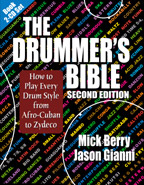 The Drummer's Bible: How to Play Every Drum Style from Afro-Cuban to Zydeco, by Mick Berry and Jason Gianni.
"The Drummer's Bible is quite an undertaking, researched and written with care. There will certainly be things to quibble about — some might feel more time should have been spent on the train beat and less on the linear-funk exercise. Others could quarrel about the authors' connection of gospel and polka grooves, or their rather stiff odd-time performances in 9/8, 13/8, 15/8, and 19/16. Still this 'bible' delivers some four hundred notated drum grooves along with a historical perspective on each genre — noble and useful features indeed. It's comprehensive up to jungle/drum 'm bass and blas beats, and includes a recommended listening guide for further study. There's even klezmer, tarantella, odd-time over-the-bar polyrhythms, and something every drummer needs to know: how to play a proper Viennese waltz.
ISBN 1-884365-32-9 / 181 pp. (8.5" X 11") + 2 CDs (now includes links to all musical examples rather than the CDs) [ Back to Books ] [ see pdf sample ]
 Free Radicals: A Novel of Utopia and Dystopia, by Zeke Teflon.
"Solidly entertaining . . . reminiscent of early Mick Farren" —Publishers Weekly (online) "[T]he plot holds the reader's interest and should appeal to a fairly broad audience." —Booklist Online "[Free Radicals] is among the best future-shock reads in years. . . . If we lived in the '60s and '70s—when audience-rattling paperbacks like Naked Lunch were cheap, plentiful and available on pharmacy-spinner racks— critics would hail Free Radicals as a masterpiece." —Tucson Weekly "Absolutely funny. . . . A very enjoyable read: . . . humorously offensive entertainment with a big dose of reality that made me laugh out loud." —westernsfa.org ISBN 9781937276058 / 303 pp. (6" X 9") [ Back to Books ] [ See pdf sample — first six chapters ]
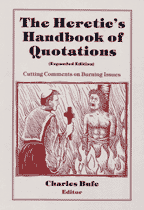 The Heretic's Handbook of Quotations: Cutting
Comments on Burning Issues (expanded edition), Charles Bufe, editor.
The Heretic's Handbook of Quotations: Cutting
Comments on Burning Issues (expanded edition), Charles Bufe, editor.
"The source for the best quotes—over two thousand in all—on topics ranging
from anarchism to the state, from law to freedom, from marxism to capitalism, from religion to
sex, from the arts to feminism, and a hell of a lot more. A timeless collection, this book
should be on the selves of every self-respecting radical."
"Most books of quotations are staid and slightly dull, worthy storehouses of conventional wisdom
and nicely polished phrases. The Heretic's Handbook of Quotations is different, as you might guess from the title.
Instead of the usual parade of familiar bromides from Shakespeare, Dickens and Winston Churchill, editor
Charles Bufe has brought together more than 2,000 quotations from socialists, anarchists,
feminists, awkward people and subversives of all kinds. The cumulative effect is like being nibbled to
death by a whole tribe of old moles of the revolution. . . . [This book] is enormous fun to dip
into . . . I enjoyed the book enormously . . ."
"The book is a far-reaching collection of timeless, provocative, politically astute quotations from a
wide range of people active in many walks of life. It is fun, informative, and more."
ISBN 1-884365-27-2 / 238 pp. [ Back to Books ] [ See Excerpts ]
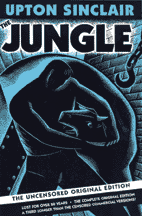 The Jungle: The Uncensored Original Edition,
by Upton Sinclair.
The Jungle: The Uncensored Original Edition,
by Upton Sinclair.
"Sinclair's 1906 masterwork has been read by countless millions — unfortunately, they only got part of the story. The standard edition that has been consumed by adults and assigned to students actually is an abridgment, cut by Sinclair in order to secure a publisher. The complete version was serialized in a Socialist publication, but no mainstream book house would touch it without butchering the manuscript. Sinclair later wanted to reinsert the expurgated material for a full-length book version but that never came to fruition. This See Sharp reprint presents the whole text, including five additional chapters as well as numerous snippets of social commentary and harsh descriptions of the meat industry, none of which has been available in previous incarnations. This title's esteemed place in American letters makes this essential for all libraries, especially at this affordable price."
"This is a revised edition of the classic by Upton Sinclair. There is a very good foreword by Earl Lee, a librarian at Pittsburg State University. The foreword and introduction give a lot of background as to why the original commercial edition of The Jungle was censored by the publishers, and a lot of information on the outcry caused by the novel, concerning the treatment of immigrant workers, and conditions in the meat packing industry in Chicago in the beginning of the 20th century. This new and enlarged edition, with much material that was left out of the original, comes at a good time, coinciding with the publication of Slaughter House Blues and Fast Food Nation, both of which discuss problems in the meat and poultry industries and the treatment of workers. If you have read the two above-mentioned books, this new edition of The Jungle is a must read. Recommended for all public, academic and junior through senior high schools.
ISBN 1-884365-30-2 / 368 pp. (oversize) [ Back to Books ]
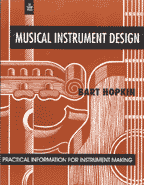 Musical Instrument Design: Practical Information for Instrument Making, by Bart Hopkin.
"Despite the subtitle, readers will not come away from this book able to construct a working violin
or trumpet. They will, however, find instructions in making more rudimentary instruments
such as a driftwood marimba or coffe cuica. The book deals with the principles of acoustics and their relationship to instrument
design in depth. Most of the chapters are devoted to the design principles of various
instrument types (e.g., idiophones, aerophones, membranophones). Also discussed are some more unusual
instruments, such as the musical saw, whistle, and intonarumori. A helpful bibliography,
glossary, and source list for materials round out the text. Recommended for most music collections.
ISBN 1-884365-48-5 / 116 pp. (8.5"x11") [ Back to Books ]
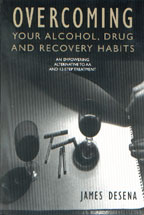 Overcoming Your Alcohol, Drug, and Recovery Habits, by James DeSena.
"James DeSena, Ph.D., is an authority on alcohol and drug addiction who has come to the conclusion that there are healthier and more effective alternatives to the traditional Alcohol Anonymous and 12-Step treatments. Based on his personal experience and research, he has written an excellent book, Overcoming Your Alcohol, Drug and Recovery Habits. "Bad medicine and faith healers have harmed vulnerable people for ages," says the author, and he cites the way too many addiction treatment providers often have their addicted patients returning time and time again without success. He says, though, that addicts can quit for good and do so without therapists and others. Studies clearly show that nearly 80% of people who quit alcohol and drug addictions did so on their own. His book takes a hard look at the addiction treatment industry and, at the same time, charts the path for those who want to quit. I heartily recommend this book." —Alan Caruba, Bookviews.com, March 2003 ISBN 1-884365-29-9 / 224 pp.  Spiritual Snake Oil: Fads & Fallacies in Pop Culture, by Chris Edwards.
Edwards, an Indianapolis resident, just published this book in July, and it's a whale of a read for those interested in stripping away the magical thinking of our contemporary world. With incisive -- sometimes brutal -- wit, Edwards pulls the veil away from such beloved cultural figures as Deepak Chopra, Robert Pirsig (Zen and the Art of Motorcycle Maintenance) and Michael Chrichton. He dismantles The Celestine Prophecy and tells the secret behind The Secret: that the book "is just the old Christian prosperity gospel reworked to take the most of the Christianity and references to God out so that the final project appeals to greater number of people." Edwards will have you prying open your mind, as you trying to stitch your side back together from laughing.
Spiritual Snake Oil: Fads & Fallacies in Pop Culture, by Chris Edwards.
Edwards, an Indianapolis resident, just published this book in July, and it's a whale of a read for those interested in stripping away the magical thinking of our contemporary world. With incisive -- sometimes brutal -- wit, Edwards pulls the veil away from such beloved cultural figures as Deepak Chopra, Robert Pirsig (Zen and the Art of Motorcycle Maintenance) and Michael Chrichton. He dismantles The Celestine Prophecy and tells the secret behind The Secret: that the book "is just the old Christian prosperity gospel reworked to take the most of the Christianity and references to God out so that the final project appeals to greater number of people." Edwards will have you prying open your mind, as you trying to stitch your side back together from laughing.
—Jim Poyser, Nuvo, July 20, 2011 ISBN 978-1-884365-79-9 / 146 pp. [ Back to Books ]
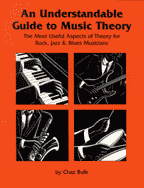 An Understandable Guide to Music Theory: The Most Useful Aspects of Theory for Rock, Jazz & Blues Musicians, by Chaz Bufe.
"Quiet as it's kept, theory is what goes on while you are playing music. You don't have to understand theory to play music,
but if you do, you will have a better handle on what you are doing.
Now if you've been in music for a while and want to figure out what is going on, Chaz Bufe's
An Understandable Guide to Music Theory is a good place to start . . . It's cleanly laid out and
printed and easy to read. . . .
Probably the first question anyone considering this book asks is: 'Will it make me play better?'
Anytime you get a better understanding of what you're trying to do, play blues or jazz, big band
tunes or any other for that matter, you can't help but play better.
If you can read a treble clef, you can understand this book."
"Geared for rock, pop, and jazz musicians who want to zero in on the theoretical topics most
relevant to their chosen styles rather than tackling formal classical theory head-on, [this]
Guide crams a remarkable amount of information into 74 pages. Presuming little reader
knowledge beyond the ability to identify the notes of the staff, Bufe plumbs the melodic and
harmonic underpinnings of Western music, explains common compositional and improvisational
techniques, and even offers an orchestration primer. While he sometimes turns to rough aesthetic
generalizations in pursuit of brevity, Bufe's explanations are rarely dumbed down: you won't have to
unlearn them should you dig deeper at a later date. Not the most comprehensive approach to the
topic, but a very expedient one."
"Chaz Bufe has designed a book that does exactly what the title claims it does. This is an excellent
way for any musician to tie together any loose ends he or she might have regarding music theory.
The language is very easy to understand and the text covers most of the important points about the
subject. Musicians who may have had difficulty in a traditional music theory class will be
relieved to find that theory doesn't have to be so threatening. The theory covered and the
manner in which it is covered are most appropriate for jazz/pop/rock musicians. Much space is
given to chord structure, chord progressions, and chord/scale relationships as they relate to
comping, arranging, and improvisation. The book even covers transpositions and ranges for most instruments.
Terms like pointilism, hocketing, and canon may be a bit difficult to grasp in a traditional music
history like Grout. In this book they become quite accessible, especially when the examples
listed include pieces by composers like Charles Mingus and Paul Butterfield! An
Understandable Guide to Music Theory is an excellent resource for any and all musicians
who are insecure about their theory chops. It's extremely user-friendly without being condescending
to the reader. I highly recommend it."
ISBN 1-884365-00-0 / 74 pp. (8.5"x11") [ Back to Books ]
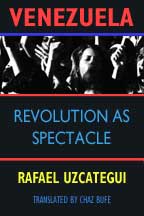 Venezuela: Revolution as Spectacle, by Rafael Uzcategui. Introduction by Octavio Alberola. Translated by Chaz Bufe.
"[Uzcategui's] is a particularly useful critique because it comes from neither the right-wing opposition, nor from overzealous Chavistas, but from someone who ardently desires real revolution for the people of Venezuela. . . .
"Chavez's revolutionary rhetoric throws off the scent from his actual governance. Luckily, there are writers like Uzcategui who see through the deception and electioneering. Uzcategui's insights make this a book about more than the failures of Chavez or the right/left dichotomy he exploits so well. Despite its title, Venezuela is a broader work about the way our world works: how governments everywhere are in thrall to moneyed interests, and how statecraft has been reduced to spectacle."
"American leftists have historically been so desperate for a little bit of hope that they have a tendency to jump on any passing bandwagon that looks even remotely like a progressive movement or government. The latest bandwagon to get the unqualified sup- port of American lefties is the so-called Bolivarian Revolution in Venezuela, led by its lider maximo, Hugo Chavez.
"To the left Chavez is the leader of a popular movement for
a democratic, 21st Century Socialism. A populist who is, at last,
using Venezuelas vast oil wealth to uplift the people and resist U. S.
Imperialism and globalization. This leftist myth is opposed by a
contrasting myth from the right: that Chavez is the reincarnation
of joseph Stalin who is bent on expropriating the capitalists and
plunging Venezuela into a totalitarian hell.
"In Venezuela: Revolution as Spectacle, Rafael Uzcategui sets out
to show that both contrasting myths are just that, myths, and that
Chavez is just one more in a long line of Latin American caudillos
(strong-men) who use populism and rhetorical anti-imperialism
to attain and hold on to personal power.
"To make his case Uzcategui uses the governments own statis-
tics and the testimony of erstwhile supporters of the "Bolivarian
Process" to examine the daily lives of ordinary Venezuelans and
discovers that daily life for the masses has not changed all that
much from pre-"Revolution" days. . . .
"Anarchists should read this book to get the ammunition they
need to counter the arguments of Chavez apologists. just as Sam
Dolgoff's expose of the Cuban Revolution, The Cuban Revolution:
A Critical Perspective, was important in opening the eyes of an
earlier generation of anarchist supporters of that lie, let us hope
that Uzcategui's critical review of the Bolivarian Revolution will
do the same."
ISBN 1-884365-77-5 / 232 pp. (6"x9")
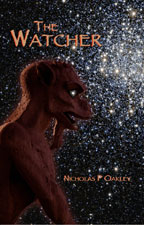 The Watcher, by Nicholas P. Oakley.
"Tian's people are hunter-gatherer nomads determined to preserve their consensus-driven, nonhierarchical society at all costs; by their lights, they are a free people. They are also abjectly poor, brutally conformist, willfully ignorant, and incapable of mustering a useful response to the predatory Qah raiders. Exiled because of her nonconformity, Tian encounters 578-MORI-AO142, one of the enigmatic Watchers; from "Mori," Tian learns much about the greater universe that her people have rejected, a universe whose brutal conflicts are about to transform her world and Tian herself. Oakley's ambitions are greater than his current skill-the frequent flashbacks are particularly obtrusive-but he provides a degree of complexity in what could very easily have been a one-sided didactic novel. This ambivalent examination of an idealist society and its less than ideal behavior offers the hope that Oakley will grow into a significant SF novelist."
ISBN 978-1-937276-45-4 / 230 pp. (6"x9")
|